Key Takeaways
- Supply chains play a critical role in both contributing to and addressing climate change, making it essential to design sustainable systems that reduce environmental harm.
- The new book by DU instructor Jim Tompkins explores how climate resilience and responsible supply chain leadership can protect the planet while ensuring business continuity.
- Integrating sustainability into logistics and procurement decisions is becoming a strategic priority for companies responding to ecological and regulatory pressures.
- Higher education programs are preparing professionals to lead green transformation efforts by combining real-world case studies with systems thinking.
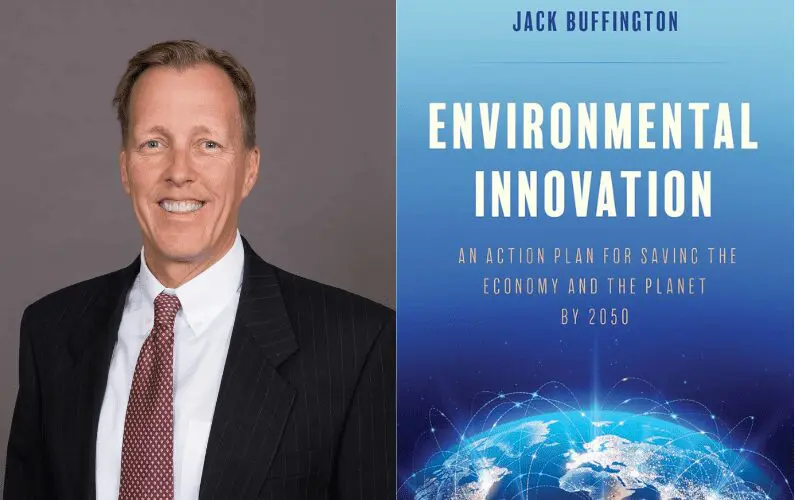
A new book from a University College leader tackles the immense problem of climate change with some innovative thinking.
Jack Buffington is a longtime executive in the supply chain industry and is now the Director of the Supply Chain Management program at University College. In his new book, Environmental Innovation: An Action Plan for Saving the Economy and the Planet by 2050, he argues that the solution to this global issue will have to come at a more localized and practical scale.
“We’ve had all these international initiatives and UN proclamations that try to address climate change, but that’s not how humans solve problems,” he says. “The innovation is going to happen at a community and individual level.”
Buffington developed expertise in packaging material science, sustainability, and recycling after working as an executive at MillerCoors and seeing the boom in single-use (disposable) materials. He has written several previous books, including Reinventing the Supply Chain, Peak Plastic: The Rise or Fall of our Synthetic World, and Frictionless Markets: A 21st Century Supply Chain. His research led him to advocate for more interdisciplinary approaches that bridge policy, science, economics, and logistics.
“That’s where I think the answers lie,” says Buffington. “The technologies are in place. It’s the human systems that are lacking.”
In his new book, Buffington outlines an action plan to meet climate goals by 2050 without sacrificing economic growth. He zeroes in on strategies in all sectors, from energy to food to materials. For example, energy utilities in the U.S. are currently highly centralized and entrenched in fossil fuel-based infrastructure. Buffington advocates for a hub-and-spoke model closer to China’s system, in which communities and households generate their own renewable energy across the grid.
“The moral of the story is: we know what the solutions are, but in certain parts of the world, including where we live, we don’t have the incentives to make this happen,” he says.
“You can’t make this about the environment or the economy. You have to solve both.”
Buffington thinks a lot about incentives. He believes that most regular consumers aren’t focused on environmental issues because they’re more concerned with their day-to-day expenses and responsibilities. “So you can’t make this about the environment or the economy. You have to solve both.”
Teaching Upcoming Supply Chain Problem-Solvers
Buffington’s deep interest in both the environment and supply chain problems means that professionals looking for a degree or certificate in sustainable supply chain systems can find exactly that at DU’s University College. As the program’s director, he focuses on teaching students how to think more holistically and use data to solve big problems.
“It’s not about memorizing facts,” he says. “In today’s world, everybody has Google, so content is irrelevant. The real magic of our program is learning to ask good questions and process the content into decisions.”
This emphasis on critical thinking means that graduates of the program are in high demand for supply chain positions.
“In supply chain and logistics, we engage in structured problem solving to figure out these problems. We don’t have the answers. We have the questions,” he says.
Buffington meets personally with every student pursuing a master’s in Supply Chain Management and helps them create a professional development plan.
“It’s cliché to say we don’t teach students what to think, we teach them how to think. But it’s true,” he says. “It’s our job to challenge people and teach them to solve big problems.”
See more on DU’s master’s degree in Supply Chain Management and the graduate certificate in Supply Chain Management.
Frequently Asked Questions
How do supply chains impact climate change?
Supply chains involve transportation, production, and logistics—all of which produce carbon emissions. Sustainable design helps reduce waste, energy use, and environmental degradation.
What solutions are outlined in the book featured in this spotlight?
The book highlights adaptive supply chain strategies, sustainable sourcing, green technology integration, and proactive leadership that focuses on long-term climate resilience.
Why should companies care about sustainable supply chains?
Regulatory requirements, consumer expectations, and environmental risk are pushing companies to rethink logistics. Sustainable practices improve brand reputation and future-proof operations.
How is DU preparing students for sustainability challenges?
Through applied learning, students engage with real industry examples and are trained to think critically about climate policy, systems impacts, and leadership in sustainable operations.