Key Takeaways
- Maps are more than navigation tools, they help people see patterns, connections, and context that are hard to understand in text alone.
- Spatial thinking supports problem-solving across many fields, because it trains you to organize information and interpret relationships.
- Learning with maps can make complex topics feel more approachable and memorable, especially for visual learners.
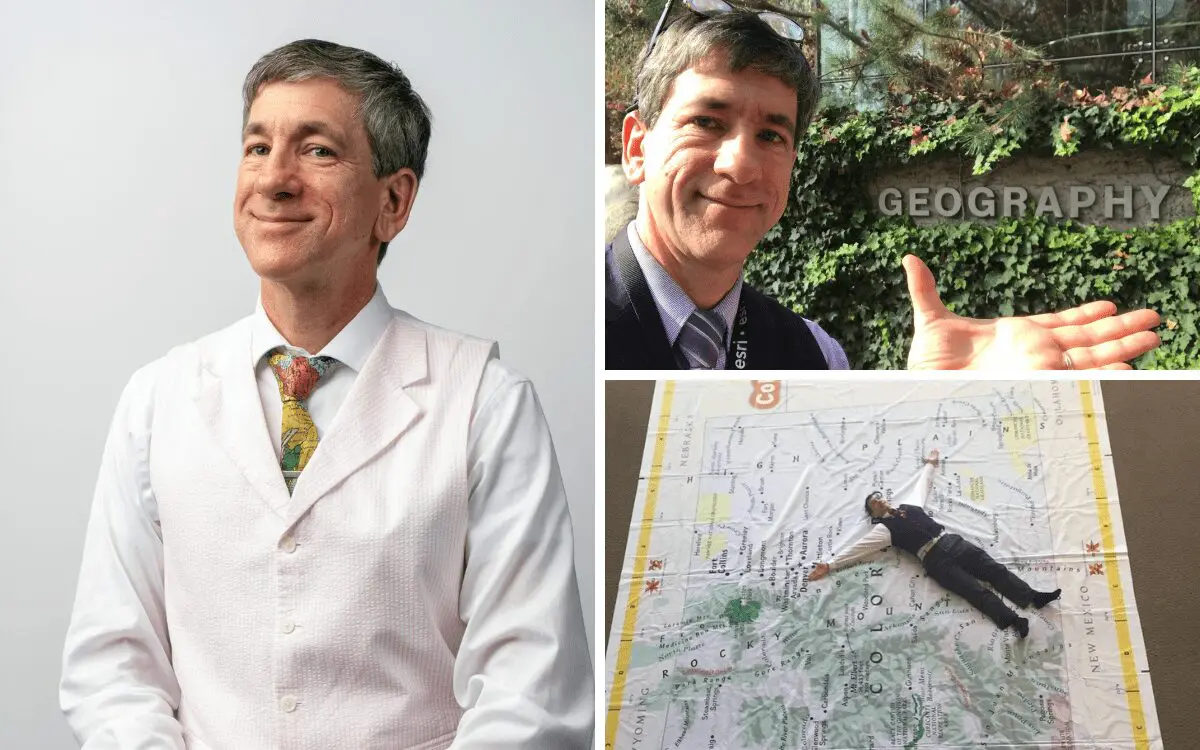
Joseph Kerski is hard to miss. He most often wears a sharp navy vest, boldly colored glasses, and an animated, bouncing enthusiasm for what he does. Kerski wants you to adore maps as much as he does.
“Place matters,” Kerski says. “Maps aren’t just relevant; they are increasingly relevant as we have an increasingly complex world. People say a picture is worth a thousand words. Well, a map is worth a thousand pictures.”
Kerski will teach “Mapping the Future” for DU’s Enrichment Program on September 9 and 16, in which he’ll explore both the long history of maps and their dazzling future. The Enrichment Program offers an array of short courses like this one, open to any community member with a sense of curiosity. Classes are offered in the evenings or via Zoom, with no tests or grades – just learning for the love of it.
Kerski is a perfect Enrichment Program instructor, as someone who is happiest talking about their area of expertise. In Kerski’s case, its geographic information systems, or GIS.
“As a child, I liked to do three things: get outside, take pictures (usually looking down from a high place), and make maps,” says Kerski, who grew up on the Western Slope of Colorado. “I also had an early instinct for conserving these natural resources. I had this sense of wanting to do my part to make the planet a better place to be.”
Today, Kerski holds his dream job. As Education Manager for the country’s leading mapping software company, Esri, he travels the country to cheerlead for GIS education and advancement. He spends his days evangelizing for GIS with students and educators, industry groups, nonprofits, government agencies and other entities. He is also a key adjunct faculty member for DU’s GIS master’s degree program.
“Maps are not just reference documents that state where things are. They’re analytical tools; they’re decision-making tools. They can tell us why things are the way they are, and how we can build a more resilient world,” he says.
He issues a litany of questions that can be answered with maps: Where do tornadoes tend to hit over a 100-year span? When a bus breaks down, how many people are on it, and what’s the quickest way to get another bus to them? How do infectious diseases spread through a population? How fast are invasive species entering a habitat? Whose home is threatened by the growth of a certain wildfire? How is income changing over time in various countries?
“All these issues, they’re all spatial,” Kerski says. “Sometimes mapping confirms our preconceived notions, and sometimes maps shatter our ideas of how the world works.”
Kerski promises his Enrichment Program class will be full of interactive moments, hands-on activities, and maybe a few puns. He keeps the energy of the class up and ties his content to what’s happening in the news to illustrate how new maps continue to be needed, long after the Age of Exploration. Students will even get the chance to use digital tools to create their own maps of personally significant spots.
“Enrichment courses are great because everybody is there just because they want to be; they want to learn something and they’re engaged,” Kerski says. “And there’s this wide variety of ages and backgrounds, which is great. I try to tie the class content to everybody’s experience, whether they’re a lawyer or a rancher.”
If you want the chance to learn about maps from this enthusiastic mapping expert, bookmark the Enrichment Program page for July 8, when registration opens for the fall term. You can also sign up for the Enrichment Program newsletter at UniversityCollege.DU.edu/Contact-Us/Enrichment-Program.
For those wanting a deeper dive into the world of GIS and spatial analysis, Kerski also co-teaches courses for DUx, DU’s online accelerated programs (open to all) that can be leveraged toward a micro-master’s certificate or even a full master’s degree through DU’s University College.
Frequently Asked Questions
Why do maps matter beyond geography class?
Maps help you understand how things relate to each other, like cause and effect, movement, and patterns across space. That kind of thinking shows up in business, public policy, history, and even everyday decision-making.
How can maps improve learning and memory?
Visual layouts make information easier to process because your brain can “see” the structure instead of trying to hold everything in a list. When you understand the relationships, you are more likely to remember the details too.
What is spatial thinking, and why is it useful?
Spatial thinking is the ability to understand how objects, ideas, or systems relate in space and scale. It helps you solve problems by spotting patterns and organizing complexity into something you can act on.
How can adults use maps for lifelong learning?
Adults can use maps to explore history, current events, travel, environmental change, and community planning in a more engaging way. It’s a practical tool that keeps learning active, not passive.